

Written by Kashfee Habib
It began, as many good things do, with a friendship: the sort that crosses oceans and decades.
In the mid-1980s, Professor Miyazawa, a Japanese academic, lived with his family at International Students House family flats at York Terrace East. What began as an ordinary stay quietly grew into something lasting and meaningful.
A few years later, while serving on a committee to celebrate Toyota City’s 40th Anniversary, Professor Miyazawa proposed the idea of an exchange scholarship to strengthen ties between Toyota City and Britain. Final efforts were made by John and Hiroko Charles to persuade Toyota City Mayor Kato to attend the ISH Garden Party to meet ISH’s first patron, the late Queen Elizabeth Queen Mother, and establish the scholarship.
Since then, each year, bright minds from the UK set out eastward, carrying curiosity and courage, while others from Toyota journey west, their suitcases filled with expectation and a quiet sense of adventure.
Anando Ghosh, from India and deep in his PhD studies in Anthropology at UCL, began his Toyota-Shi Trevelyan journey with an unexpected teacher — the simple, magical act of communication itself.
“When I learned to speak honestly and respectfully, I realised that understanding begins where fear ends,” he recalls.
His host family — Ko-San, Shiho-San, and their two lively children — opened their home and hearts to him. Evenings were filled with stories, laughter, and the gentle hum of language exchange.

“Shiho-San would cook every dish by hand,” Anando remembers, “and every meal felt like a poem about care.”
There were moments of quiet revelation too: a breeze whispering suzushii [“cool”] on a hot day, the hush before Mount Fuji unveiled itself from behind the clouds.
“That moment taught me that belonging can appear without warning — like sunlight after rain.”
Through shared meals, soft silences, and the rhythm of everyday kindness, Anando discovered that cultural exchange is not about observing but about participating.
“Japan taught me that empathy is a language of its own,” he says, his voice carrying both warmth and wonder.
If Anando’s story was written in whispers, Sandesh Timsina’s unfolded in vivid hues.
“Japan enveloped me in its graceful rhythm, deep traditions, and quiet sophistication,” he writes.
A Nepalese masters scholar of digital media at London Metropolitan University, he was enthralled by Japan’s maximalist design — “coruscating colours, bold typography, and a symphony of visual information.”
But it was the people who coloured his days. His host family — Eri-San, Yoshi-San, and their son — took him to Nara, Ghibli Park, and even the seaside.
“They cared for me with such warmth that Japan felt like home,” he says simply.
From calligraphy to cormorant fishing, from the quiet grace of shrines to the comforting slurp of udon, Sandesh found beauty in every corner.
“It began as a study trip,” he reflects, “but became a journey of understanding and gratitude — one I’ll carry with me always.” And with a grin he adds, “Also, the toilets — the best in the world!”

While Anando and Sandesh wandered through shrines and sushi stalls, three scholars from Toyota City — Kotoko Shiozaki, Nana Shibata, and Manami Chikada — crossed the same bridge in the opposite direction, discovering the many shades of British life.
Kotoko Shiozaki, studying in Derbyshire, found wonder in the details of everyday courtesy. “People greet the bus driver and thank them when getting off — it’s such a small thing, but it stays with you,” she noted. For her, each hello and thank you became a gentle lesson in openness.
Nana Shibata saw a different side of Britain — its crisp air, cathedral bells, and the calm rhythm of provincial life. “Derby was not a famous city, but it became my favourite classroom,” she wrote, finding warmth in fish-and-chips suppers, evening chats in the dormitory, and the quiet kindness of strangers on trains.
Manami Chikada, meanwhile, gazed at London through a thoughtful lens, observing its demonstrations, debates, and diversity. “What I felt on the ground was not rejection but a deep struggle for identity,” she wrote, reflecting on how Japan might learn from Britain’s complex mosaic of cultures.
Each scholar, in their own way, discovered that the UK was not just a place to study English, but a mirror through which to see Japan — and themselves — more clearly.
Though separated by language and longitude, the scholars’ experiences wove together into a single tapestry of learning and friendship.
John Charles, who was there at the beginning, helped guide the early years of the programme with characteristic grace and enthusiasm. Though he is no longer with us, his legacy endures through the continuing work of Hiroko Charles who continues to serve as trustee, ensuring that this enduring friendship between Japan and the UK continues to grow.
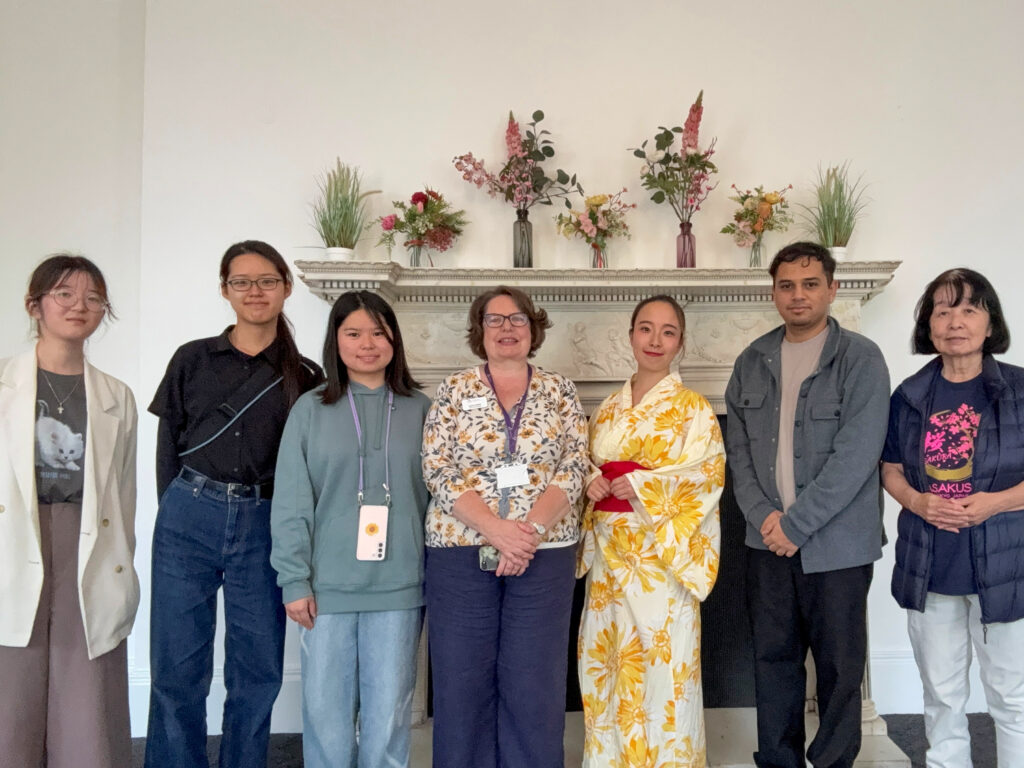
“It was a privilege to meet both sets of scholars this year, preparing the ISH residents for their trip to Japan and seeing the Japanese scholars on a visit to International Students House. I am delighted that this exchange, conceived long ago, still continues to this day,” reflects Hiroko Charles.
From the tea ceremony set gifted by Professor Miyazawa’s daughters in the 1980s to the laughter echoing through modern dormitories, the Trust’s purpose has remained unchanged: that is to nurture the quiet magic of connection.
As Anando put it, “The most lasting legacy of this scholarship isn’t knowledge, but relationships built.” Sandesh agrees: “It became a journey of gratitude.”
And the Japanese scholars, now back in Toyota, carry their own memories of Britain — of rain and cathedrals, bus drivers and smiles — proof that a bridge, once built on friendship, never stops growing.
Have you also read these articles?
2026 Projects for Peace Grant Recipients (ISH)
Two ISH Residents are going to Japan this summer, 2024
